

When Platforms Grow Too Powerful
How AI Is Pushing Digital Ecosystems Out of Balance

Instead of the usual messages of compassion and warmth this time of year, social media felt noisier than ever. Newsfeeds were dominated by outrage, conspiracy, and provocation. The content amplified not for its insight or contribution, but for its ability to capture attention. With generative AI, deepfakes, and increasingly persuasive models, many fear that 2026 will bring even greater volatility to our public conversation.
While writing Changing Fast & Slow, I kept returning to a critical dilemma. The digital platforms that deliver unprecedented efficiency, connectivity, and innovation are increasingly the same ones that concentrate power, influence public discourse, and shape decision-making on a global scale. What began as a technological triumph is now becoming a societal challenge.
Our book explores how organizations transition from linear product pipelines to platform ecosystems, from scarcity to abundance, and from control to orchestration. But one question hovered over the work: what happens when platforms scale faster than our ability to govern them?
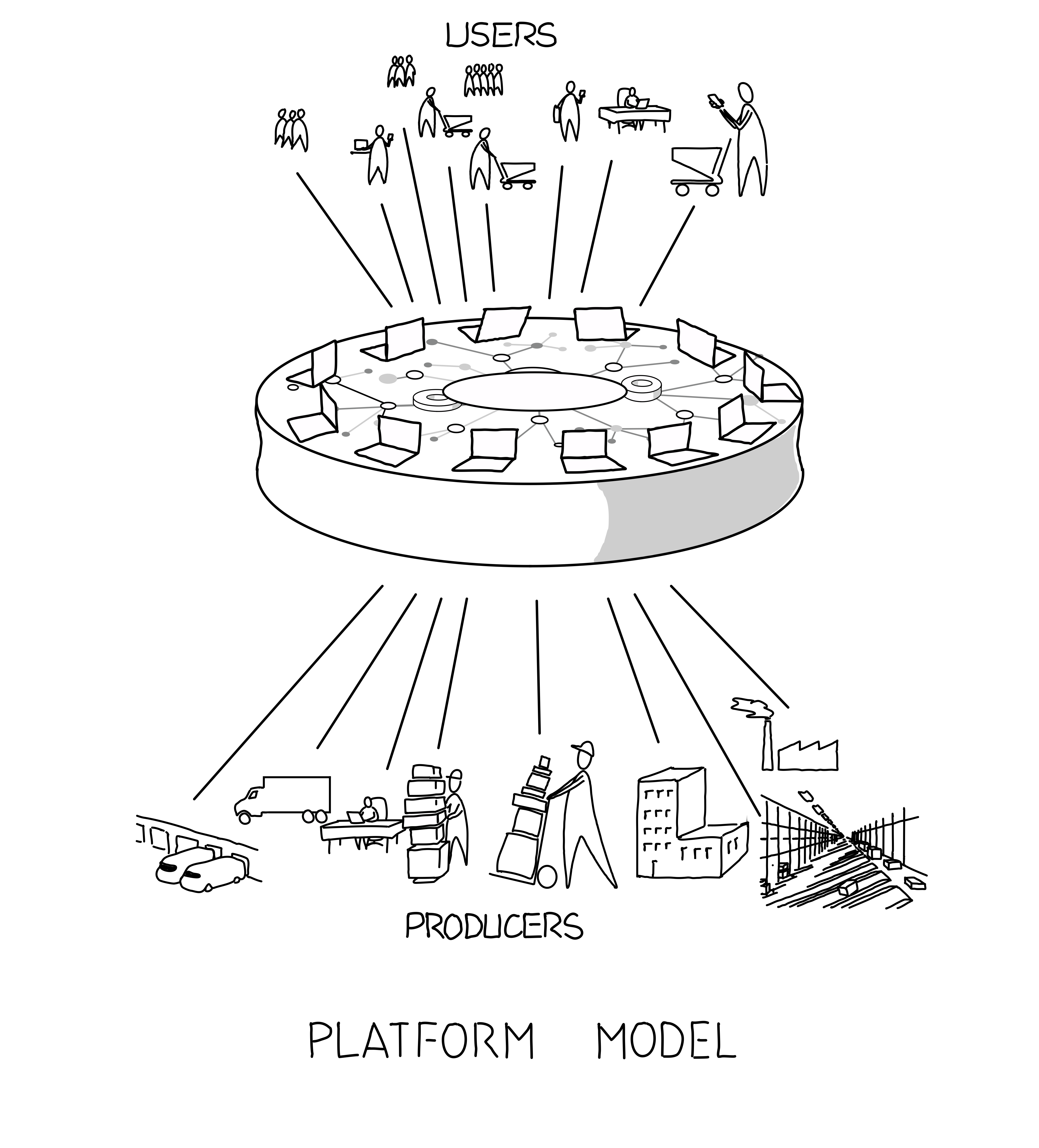
In this essay, I examine the winner-takes-most dynamic. It explains why the very forces that empowered digital platforms are now generating systemic risks, and why a federated network of platforms may offer a way forward, particularly for laggards like the EU.
Scale as the Evolutionary Advantage
The initial phase of the digital economy was defined by scale. A few companies, such as Amazon, Google, and Meta, grew quickly, gathered large amounts of data, and established strong moats. Network effects kept users engaged, vertical integration increased control, and large-scale AI improved competitive advantage.
Today, these organizations are no longer merely marketplaces or social networks. They have become ecosystem hubs: central nodes on which millions of businesses, creators, and institutions depend. That concentration brings undeniable benefits: global reach, operational efficiency, and vast innovation capacity.
The current GenAI wave is poised to accelerate this dynamic even further. Massive investments in data centers, foundation models, and financial cross-holdings are consolidating power at a pace that raises profound societal questions.
Scale itself is not the problem. The problem emerges when scale is combined with concentrated control, unpredictable outcomes, and opaque governance.
When Strength Turns into Fragility
In natural ecosystems, the species that grows the fastest and consumes the most resources often appears to be the strongest until it destabilizes the system that supports it. The same pattern is now emerging in the digital economy.
The qualities that made dominant platforms so successful—scale, speed, efficiency, and centralized control over data—are also what throw the ecosystem out of balance. These platforms reshape their environment to support their own growth, pushing out diversity and reducing overall resilience.
Their business models depend on continuously extracting signals from human behavior: tracking, profiling, predicting, and influencing. Surveillance is not an unintended side effect; it is the metabolic core of the system. Targeted advertising, personalized feeds, and engagement optimization function much like an organism optimized to consume attention as its primary resource. Privacy erosion is therefore not an accident, but a design choice. We tolerate this because the services are convenient and free.
As the dominant species in the digital ecosystem, platforms can change the rules of survival. They can exclude competitors, influence user behavior, and set their own terms for participation. Their algorithms, secretive and proprietary, are designed for engagement and growth. This creates systemic stress: distorted markets, polarized discussions, and the spread of misinformation.
With generative AI, this influence goes beyond commerce to shape meaning itself. Platforms increasingly decide how information is discovered, how communities stay connected, and how shared stories evolve. When individuals like Elon Musk or Donald Trump control major social networks, the line between private infrastructure and public conversation blurs. Recommendation engines and newsfeeds serve as de facto speech regulators. They are powerful, adaptable, and mostly unaccountable.
Who Sets the Guardrails?
This asymmetry deepens the challenge. Global platforms move faster than governments react, adapt more quickly than regulatory processes, and operate across jurisdictions with ease. As a result, some of the most consequential decisions about data, speech, and digital infrastructure are no longer made in democratic institutions, but in corporate boardrooms.
“If the world continues to approach AI with a profit-driven mindset, there is a bigger likelihood of an AI takeover or bad actors co-opting the technology for dangerous means like mass surveillance.” Geoff Hinton
The risks we face are not anomalies caused by a few actors. They are structural outcomes of extreme concentration without meaningful counterbalance. Codes of conduct and ethical principles exist, but they are typically self-defined, non-binding, and unverifiable. This is ethics as branding rather than embedded governance.
Organizations with such outsized power should be required to publish their ethical frameworks and submit them to independent verification. Without external accountability, ethical governance remains optional. Technology scales effortlessly; trust does not.
GenAI and the Limits of Rules-Based Regulation
A crucial distinction is often overlooked: the difference between complicated and complex systems. Complicated systems can be decomposed, predicted, and controlled through rules and policies. Complex systems cannot. They evolve, adapt, and exhibit emergent behavior.
Large language models and other foundation models already analyze vast datasets, generate content and software, and perform increasingly autonomous tasks. Combined with sensors capturing sight, sound, movement, and touch, AI is becoming multimodal. The major players are integrating multiple forms of intelligence into a single, adaptive system.
The opportunities are extraordinary. AI is already reshaping professional services such as law, accounting, marketing, media, commerce, and scientific discovery by inferring preferences, anticipating needs, and continuously adapting outputs.
But risk scales just as fast. Deep engagement can slide into manipulation. Personalization can become exploitation. Algorithms may amplify bias and misinformation or subtly nudge users toward harmful outcomes. When fake is no longer distinguishable from real, fact from fiction, then static rules become difficult to enforce. Rules-based regulation assumes stable boundaries and predictable cause-and-effect relationships, assumptions that no longer hold in self-learning, adaptive systems.
Transparency, Testing, and Risk
This is precisely the concern raised by Dario Amodei, CEO of AI research lab Anthropic. As AI systems grow more capable and autonomous, he has argued, developers must be transparent about risks and governance mechanisms to avoid repeating the mistakes of past industries.
“To fully realize A.I.’s benefits, we need to find and fix the dangers before they find us.” Dario Amodei
Amodei has called for federal transparency standards that would require leading AI platforms to disclose their safety testing and risk-mitigation practices prior to large-scale deployment.
He has also emphasized the need for built-in guardrails—“like bumpers on an experiment”—to monitor and constrain dangerous capabilities before they reach society at large. The broader lesson is clear: voluntary self-policing is insufficient. Independent evaluation, shared standards, and public scrutiny are essential in an accelerating AI race.
Federated Platforms as a Counterbalance
Alongside calls for transparency and guardrails, a different platform model is quietly re-emerging. Federated platforms distribute power rather than centralize it. They embed interoperability instead of lock-in, enable participation rather than extraction, and integrate ethical principles into governance rather than relegating them to marketing statements.
These systems are not new. Shared payment networks, travel reservation systems, and agricultural cooperatives have operated this way for decades (sometimes for centuries), pooling resources while preserving local autonomy. The Internet itself is a federated network.
“From its earliest design, the Internet was conceived as a network of networks—a federated architecture of interoperating systems based on shared protocols rather than centralized control.” Internet Working Group
In healthcare, initiatives such as Graphite Health, founded by Intermountain, Emory, and SSM Health, have introduced the idea of a Digital Hippocratic Oath. Participating organizations commit to principles of transparency, privacy, and fairness, subject to independent verification.
Similar federated efforts are emerging across mobility, energy, and data-sharing ecosystems, where governance relies on consensus and shared protocols rather than unilateral platform mandates.
These platforms are slower to scale, harder to govern, and less attractive to venture capital than fast-growing monolithic players. But in trust-intensive domains such as healthcare, education, and public infrastructure, alignment and quality matter more than speed.
India has built the impressive “IndiaStack” with super-scaled trusted identity management, seamless verification, and secure financial transactions for hundreds of millions of people. Nandan Nilekani, the chairman of Infosys and the godfather of India’s digital infrastructure, proposes a robust AI trust framework to enable India to harness the benefits of AI for billions.
“China has overtaken the US in the global market for “open” artificial intelligence models, gaining a crucial edge over how the powerful technology is used around the world.” Financial Times
China’s role in the global race for AI capability adds another dimension. As the Financial Times recently observed, China has overtaken the US in the market for “open” AI models. This is definitely not an endorsement of China’s governance model, but a reminder that openness and scale are not inherently incompatible. Initiatives such as DeepSeek demonstrate that alternative trajectories remain possible.
Large-scale federation and open source may be a good strategy for the EU to address fragmentation while preserving sovereignty. It could create a federated EU identity and access system and a trusted AI network.
From Dominance to Stewardship
The real danger of the winner-takes-most trap lies not only in its concentration of power but also in how convincingly it equates scale with progress. Healthy ecosystems do not eliminate strong species; they ensure that no single one dominates the system.
To realize AI’s promise, both economically and societally, we must shift from control to orchestration, from centralized dominance to distributed stewardship, and from opaque algorithms to transparent, verifiable guardrails. The goal isn’t to dismantle successful platforms but to foster healthier ones: interoperable, auditable, and governed by shared values instead of unilateral incentives.
This is not just a technical challenge. It is a leadership challenge for policymakers, platform executives, investors, and ecosystem builders alike.