

How AI Is Eating Software
And Why Products Are Turning into Living Ecosystems

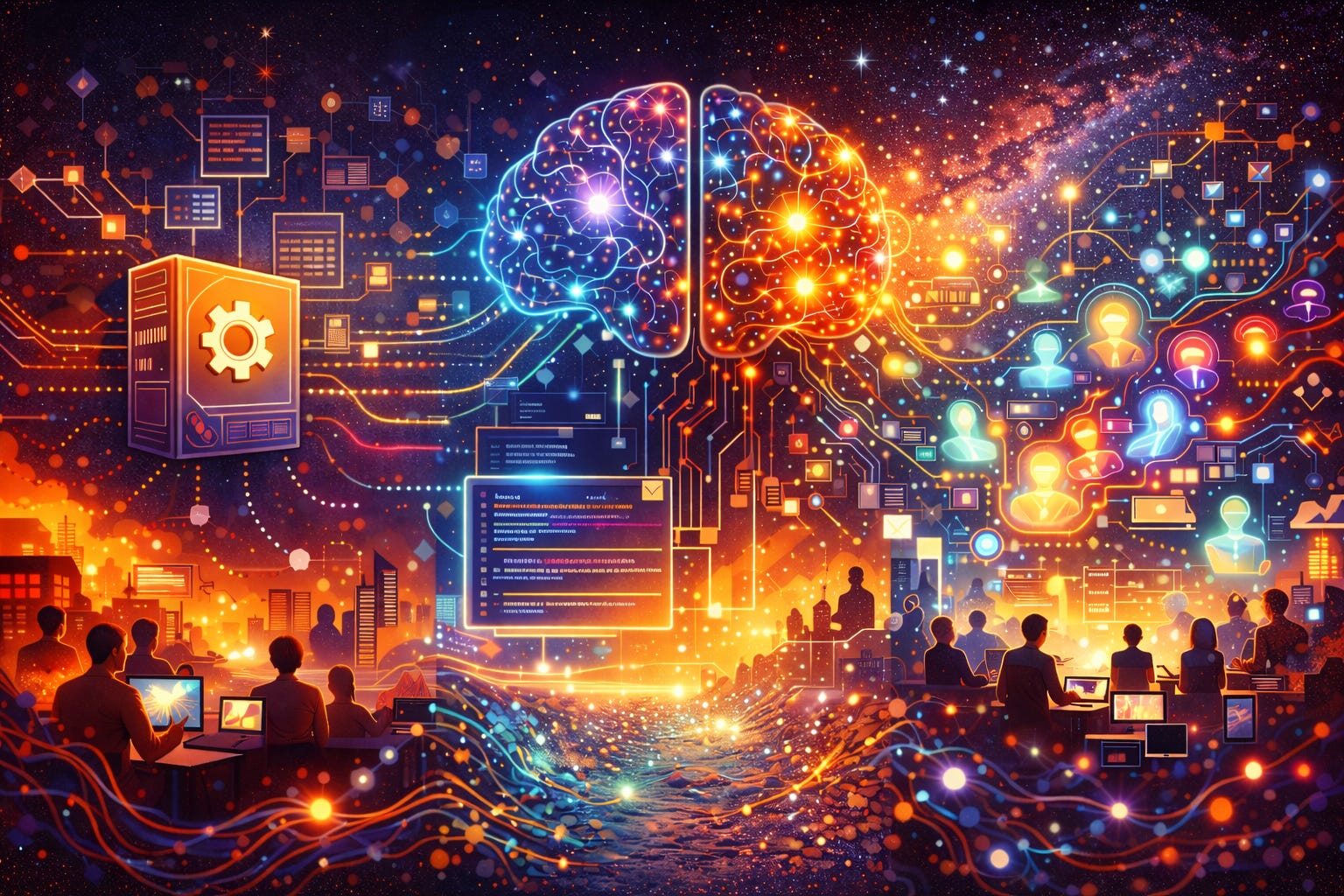
Something important has been happening in the software industry, and the stock market has taken notice. Recently, many packaged software companies, long regarded as among the safest investments in the digital economy, have been revalued. This isn’t because digital transformation has slowed down or demand for technology is waning. It’s because a deeper understanding is emerging: AI isn’t just running on software; it is becoming the software itself.
“Over 90% of Claude’s code is now written by AI.” Anthropic
Large language models are trained on patterns in language. Programming languages like Python and Java are highly structured and logic-driven. That makes software uniquely exposed to generative AI. It can now write code, document, analyze, debug, refactor, test, integrate, and increasingly maintain and improve software on its own.
As these capabilities expand, a fundamental shift becomes unavoidable. Organizations will bring much of software development back in-house, and agile startups will offer new products not by hiring large teams of engineers but by managing AI systems that continuously build and evolve digital capabilities.
What emerges is not merely cheaper software. It is a fundamentally new model of how software is created, integrated, owned, and monetized.
From licensed products to living systems
For decades, enterprise software followed a familiar logic. Vendors built products, protected them as intellectual property, licensed them to customers, and charged recurring fees. Systems integrators customized those products, maintained them, and earned margins on implementation and change.
This model relied on the scarcity of skills, expertise, and tools. AI eliminates that scarcity at its core. It is the ultimate technology of abundance. When software can be generated, modified, and optimized continuously by AI, static functionality becomes less defensible. The value no longer lies in predefined features but in how systems learn, adapt, and improve over time.
This is why software is being repriced. Not because revenue disappears, but because where value resides is shifting to new layer that integrates, interprets and generates actionable insights.
Regenerative software: a different ontology
I recently saw this shift up close through my son’s work at a fast-growing scale-up. They are rethinking how their platform evolves. They consider software as a living system that regenerates through feedback loops. AI agents continuously observe how users interact with the system, identify inefficiencies, propose improvements, and update workflows. Humans remain firmly in the loop — reviewing, approving, and guiding — but the system itself evolves day by day.
This is not a feature upgrade cycle. It is a different software ontology. The platform improves as it learns how it is being used. The boundary between development and operations dissolves. Software becomes a living system: sensing, learning, and adapting in real time.
“Once in a while, the technology comes along that is so powerful and so broadly applicable that it accelerates the normal march of economic progress.” Andrew McAfee
Once you see this model, it becomes clear why traditional packaged software struggles to compete. Static products cannot keep up with continuously evolving systems.
From process-centric to data-centric intelligence
Traditional enterprise systems are built around predefined processes. They encode best practices, workflows, and rules and then enforce them.
AI-native systems work differently. They are data-centric, not process-centric. Intelligence emerges from large, continuously updated, and contextualized data flows rather than from fixed logic. Context is king. Meaning is inferred from patterns across vast and heterogeneous sources: internal data, external signals, unstructured content, and real-time context.
When I asked an AI system to help with a market analysis, it didn’t just summarize internal documents. It actively pulled in external reports, regulatory updates, competitive signals, and market commentary, synthesizing insights that no single internal system could have produced. Claude’s Model Context Protocol (MCP), which allows AI models to securely connect to external tools, data sources, and software, may be its most powerful capability.
The insight here is not that external data is useful. It is that insights increasingly emerge at the ecosystem level, not within organizational boundaries.
Hyper-integration and agent-based systems
As AI becomes embedded across functions, software architectures are shifting again. Instead of monolithic systems and tightly coupled modules, we see agent-based architectures emerge. Specialized AI agents interact, negotiate, and coordinate across domains, such as finance, operations, customer engagement, and supply chains.
Integration no longer means building interfaces between systems. It means orchestrating intelligent agents that dynamically collaborate.
This fundamentally changes how organizations operate. Work becomes probabilistic rather than deterministic. Outcomes emerge rather than being fully specified. Control shifts from planning to continuous sense-and-respond.
“If you give something that’s insecure complete and unfettered access to your system and sensitive data, you’re going to get owned.” Gary Marcus
This power, however, demands new forms of governance. Security, data integrity, and trust cannot be afterthoughts. They must be designed into the system from the start as first-class architectural concerns. As experiments like Moltbot have shown, loosely governed agents can quickly produce unintended behavior.
Why software is being repriced
Seen through this lens, the market reaction makes sense. Traditional software companies are valued on predictable license revenues, lock-in, and switching costs. But when software can be generated and regenerated by AI, defensibility moves elsewhere: toward data access, ecosystem position, learning loops, and orchestration capability.
Markets are repricing it for a different economic logic. This doesn’t mean software companies disappear. It means their foundations change.
Those who continue to sell static products will struggle. Those who reposition themselves as orchestrators of living ecosystems will thrive.
A generational shift in mindset
What strikes me most is how natural this shift feels to my kids’ generation of builders. For them, software is not something you finish. It is something you grow. AI is not a tool you bolt onto legacy systems, but a co-creator embedded in the system from day one. Control matters less than adaptability.
This is where many established organizations hesitate. They are optimized for efficiency, predictability, and control; precisely the qualities that AI-native systems dissolve. They are facing the innovator’s dilemma.
The real challenge is not technological. It is cultural and organizational. Leaders must move from designing products to cultivating systems. From managing operational plans to enabling learning loops. From control to orchestration.
From products to living ecosystems
We are witnessing a transition as profound as the shift from physical to digital. Software is no longer just a product you buy. It is becoming the living nervous system of organizations and ecosystems: sensing, learning, and evolving continuously.
The question for today’s leaders is not whether this transformation will happen. It is whether they are still building products or designing living systems capable of thriving in constant change.
While writing our book Changing Fast & Slow, I kept returning to one question: what happens when the pace of technological change outruns the organizational models we’ve built to manage it? This essay continues that exploration. It reflects conversations with founders, operators, and the next generation of builders, who experience AI not as a tool, but as a native part of how systems are designed and evolved. If you’d like to explore the broader framework behind this thinking, you can find more context and essays here:
https://changingfastslow.com